EV Charging Cost in Saudi Arabia: Complete 2026 Guide
How much does it cost to charge an electric car in Saudi Arabia? Home charging costs about 18 halalas per kWh. See public charger prices and worked examples.

Short answer: Charging an electric car at home in Saudi Arabia costs about 18 halalas per kWh, or roughly SAR 11 to fill a 60 kWh battery from empty. At public stations the price is usually between SAR 0.65 and SAR 0.99 per kWh, so the same battery costs about SAR 39 to 59.
Cost summary for charging a 60 kWh battery
| Charging method | Price per kWh | Cost of 60 kWh |
|---|---|---|
| Home (first tier: up to 6,000 kWh per month) | SAR 0.18 | SAR 10.80 |
| Home (every kWh above 6,000 per month) | SAR 0.30 | SAR 18.00 |
| Public fast charger (50 kW) | SAR 0.65 | SAR 39.00 |
| Public ultra-fast charger | SAR 0.99 | SAR 59.40 |
The figures are approximate and assume a full charge, ignoring charging losses of about 10%. Public prices vary by operator and charger power; the prices shown are those published for EVIQ chargers.
How is household electricity priced in Saudi Arabia?
Saudi Electricity Company bills residential customers in two tiers based on monthly consumption:
- First tier: 1 to 6,000 kWh per month at 18 halalas per kWh.
- Second tier: consumption above 6,000 kWh per month at 30 halalas per kWh.
The tiers are progressive, so the 30 halala rate applies only to the kWh above 6,000, not to all your consumption. If your home uses 6,500 kWh in a month, you pay 18 halalas on the first 6,000 (SAR 1,080) and 30 halalas on the remaining 500 (SAR 150), for a total of SAR 1,230.
VAT may be added to your bill and tariffs can change, so check the company's official website for current rates.
How much does it cost to charge your electric car at home?
The formula is simple: cost = energy charged (kWh) × price per kWh. For a 60 kWh battery:
- A full charge (60 kWh) at SAR 0.18 per kWh = SAR 10.80.
- A daily top-up from 20% to 80% (about 36 kWh) = SAR 6.48.
- If your home has already passed 6,000 kWh this month, the extra 60 kWh costs SAR 18.
How much does public charging cost?
Public charging costs more because the price covers the charger, the site and operations on top of the electricity. According to the published prices for EVIQ chargers, the price is about SAR 0.65 per kWh for a 50 kW charger and about SAR 0.99 for higher-power chargers. AC charger prices at shopping centers vary by operator, so check the operator's app before you start charging.
In return you get speed: fast chargers can bring the battery to about 80% in roughly 30 to 60 minutes, depending on the charger's power and what your car accepts.
What does 100 km cost?
Assuming your car uses about 16 kWh per 100 km (this varies by model, driving style and weather), the cost is roughly:
| Where you charge | Cost of 100 km |
|---|---|
| Home (SAR 0.18 per kWh) | SAR 2.88 |
| Public 50 kW charger (SAR 0.65 per kWh) | SAR 10.40 |
| Public ultra-fast charger (SAR 0.99 per kWh) | SAR 15.84 |
Home charging costs far less than the fuel for a conventional car, while public fast charging can come close to fuel cost in some cars. That is why home charging suits daily use and public chargers suit long trips.
How long does it take to charge an electric car?
It depends on the charger's power and the maximum your car accepts. To charge 60 kWh from empty, in theory:
| Charger power | Approximate time |
|---|---|
| 7 kW | About 8.5 hours |
| 11 kW | About 5.5 hours |
| 22 kW | About 2.7 hours |
The rule of thumb is time ≈ battery capacity ÷ charger power. A 90 kWh battery on a 22 kW AC charger (such as the Voltie 22 kW home charger) takes about 4.1 hours (90 ÷ 22). Actual time varies with the current charge level, how much power your car can accept, battery temperature, and the efficiency of the charger and the electrical system.
If your car's onboard charger accepts less power than the charger delivers, the lower figure sets the real speed.
How can you save on charging?
- Charge at home overnight whenever possible. It is the cheapest option available.
- Use a dedicated home charger instead of a regular socket. It is safer and faster.
- Set the charge limit to 80% for daily use and raise it to 100% only before long trips.
- Connect the charger to home solar power if your home has it, so you rely less on the grid.
- Plan your trips so you depend less on the more expensive fast charging.
Home charger installation with Auton
Auton is a Saudi company that sells and installs EV chargers, adapters and cables for homes and commercial projects. We start with a site assessment to check the capacity of your electrical panel and the right cable route, then install the charger, test it and hand it over ready to use.
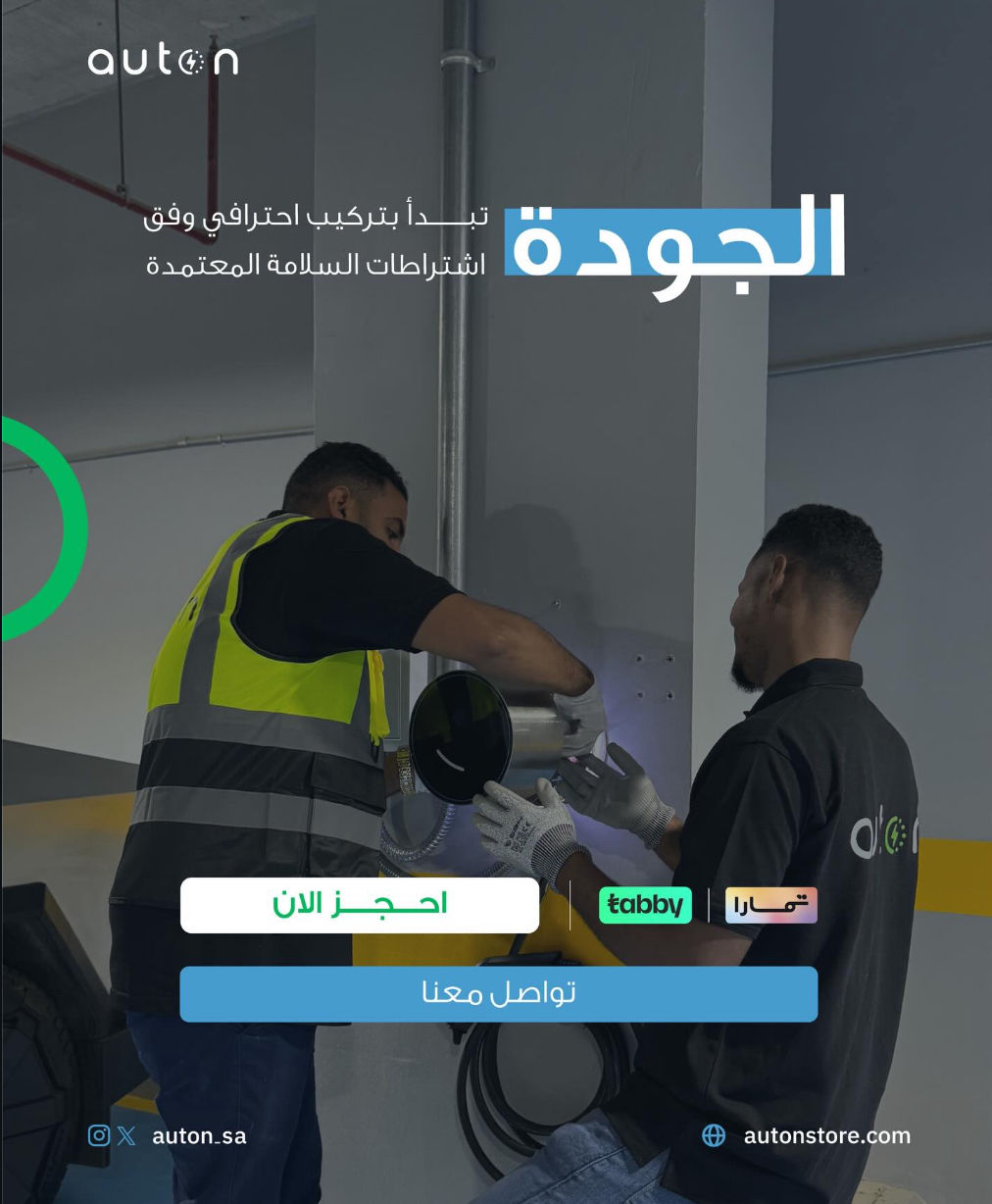
Choose from our home chargers, such as the Voltie 22 kW or the Autel MaxiCharger 12 kW, and add a Type 2 charging cable or any of our adapters and charging cables if you need them. Then book a site assessment or call us on 920032620. For businesses and property owners, see our charging solutions for business and fast charging stations.
Frequently asked questions
How much does a full home charge cost for an electric car?
About SAR 10.80 for a 60 kWh battery at the 18 halala tariff, before charging losses, which add about 10%. The amount varies with your car's battery size.
Is charging cheaper than gasoline?
At home, yes, by a wide margin. At public fast chargers it costs more, and in some cars it can come close to the cost of fuel.
How much does it cost to install an EV charger at home?
It depends on the price of the charger you choose, the distance between your electrical panel and the installation spot, the supply type (single or three phase) and the condition of the existing wiring. That is why an accurate cost starts with a site assessment.
Do I need a dedicated home charger?
It is recommended. A dedicated home charger is designed to run continuously for hours and offers better protection and speed than a regular socket. A qualified technician should install it after checking the electrical panel.
How long does home charging take?
Roughly 3 to 9 hours for a 60 kWh battery, depending on the charger's power (from 22 down to 7 kW) and what your car accepts.
Read next: GB/T vs CCS2: Differences and Why EV Adapters Cost More
Sources: Saudi Electricity Company residential tariff and the published prices for EVIQ chargers. Last reviewed: October 2026.